Sports Science Update: Stretch First To Run Slower

by Matt Fitzgerald

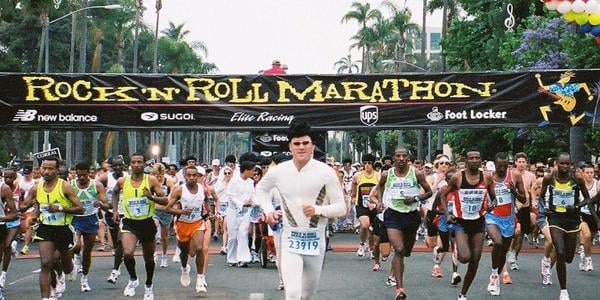
A marathon gives you plenty of time to warm up during the race. Photo: ASI

A marathon gives you plenty of time to warm up during the race. Photo: ASI

A new study finds that static stretching before running reduces running economy and performance.

Whether, when, and how runners should stretch are hotly debated questions lately. A new study by researchers at Florida State University may settle the specific question of whether runners should engage in static stretching (held passive stretches such as toe touches) before running. Ten trained male runners participated in the study. On separate occasions, they ran for one hour on a treadmill, beginning with 30 minutes at a moderate pace and ending with a 30-minute performance test wherein the runners were instructed to cover as much distance as possible. The runners performed 16 minutes of static stretch for the major muscle groups of the lower body before one of the runs and just sat around for 16 minutes before the other.

On average, the runners ran 3.4 percent farther in the non-stretching performance test than they ran in the post-stretching performance test. Yet while they ran farther after not stretching, they burned 5 percent fewer calories, indicating that pre-run static stretching sabotaged running performance by reducing running economy. These results were published in the Journal of Strength and Conditioning Research.

Why would a static stretching warm-up make you run less efficiently? The authors of previous studies have speculated that static stretching warm-ups temporarily reduce musculoskeletal stiffness. While the word “stiffness” generally has negative associations with respect to athletic performance, a certain type of stiffness is beneficial to running performance. When you run, your legs function as springs that repeatedly bouncing off the ground, capturing “free” energy (i.e. energy that the body does not have to generate for itself) from each impact and using it to for forward thrust. Just as a loose mechanical spring (think of a worn automobile shock absorber) is less effective than a stiffer one, a less stiff leg (resulting from laxity at key muscle-tendon junctions) bounces less effectively off the ground during running. Consequently, the leg captures less “free” energy from the round and running economy is reduced.

  • bigderr4
    What would happen if you reduced to time to 8-10 minutes? Just a thought. 16 minutes maybe to long.
  • SFry
    16 minutes sounds like a lot of static stretching. What about a brief stretching session? What about dynamic stretches?
  • Dynamic stretching way over-rules static stretching in most research. Static stretching over stretches the muscles increasing range of motion too much and increasing overall laxity of the muscles.

    As an Masters student in Exercise Physiology: here is what some research and evidence I have looked at says:

    Dynamic stretching increases the power for both slow and fast movements to enhance musculature performance. (Manoel et al., 2008) Two possibilities have been suggested as to why dynamic stretching induces greater muscle power output. First, muscle temperature increases have in turn increased dynamic short-duration performances from intramuscular friction that occurs during exercise. (Bishop, 2003) Increased muscle temperatures allows for an increase in the transmission rate of impulses and ultimately an increase in the force-velocity relationship. Second, the neuromuscular mechanism of a postactivation potentiation and postcontraction sensory discharge increase overall muscle force. Essentially, the increase in neural activity movement reflexes pre-condition the muscles allowing for powerful force contraction. (McMillian et al., 2006)
blog comments powered by Disqus