The Art and Science of Marathon Pacing
- By Matt Fitzgerald
- Published Nov. 11, 2010
- Updated Nov. 9, 2011 at 11:20 AM UTC
Why we hit the wall in marathons, and how not to.
Written by: Matt Fitzgerald
My first marathon was the 1999 California International Marathon in Sacramento. As I trained for it, many of my friends who were marathon veterans gave me the usual warnings to “respect the distance,” pace myself conservatively, and avoid setting too ambitious a goal. I truly believed that I would heed this advice, but I did not. My 6:06 first mile felt so easy that I decided to forge ahead at that pace. Consequently, by the 18-mile mark I was walking. I finished in 3:34, after having run the first half in under 1:23.
My second marathon was the 2000 Long Beach Marathon. I truly believed I had learned my lesson and started at a slightly more conservative pace than I had in Sacramento, despite the fact that I was now fitter. But by the 23-mile mark I was again walking. I finished in 3:11, a scant 26 minutes off my goal time.
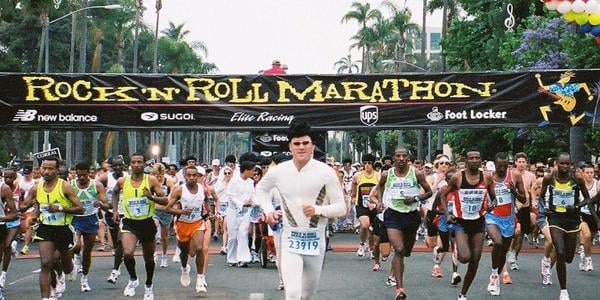
Not until I ran my third marathon did I run my first halfway decent one. I finished in 2:46:42 at the 2001 Rock n’ Roll San Diego Marathon. Yet while I did not fall apart in this race as I had in my first two marathons, I still slowed substantially in the closing 5K. My average pace over the first 23 miles was under 6:20 per mile, but my last mile was run in the range of 7:30.
If I have learned only one thing from the 14 marathons I have now run it’s that pacing oneself optimally in a marathon is very difficult. The only marathons in which I have not run the second half substantially slower than the first are the few I have run non-competitively, as workouts. I don’t have this problem at shorter distances. My pace is almost always metronomically steady in 5K’s, 10K’s, and half marathons, even on my bad days.
I am hardly unusual in this regard. The vast majority of experienced runners are able to pace themselves well in shorter events but bonk to some degree before they reach the finish line in marathons. For example, in the 2007 California International Marathon, which happens to be the most recent marathon I’ve run, only 24 of the top 100 finishers managed to run the second half of the race no worse than one minute slower than the first. By contrast, in the 2008 Carlsbad Half Marathon, only eight of the top 100 finishers slowed to a similar degree.
Why is pacing the marathon so much more difficult than pacing shorter races? And for that matter, considering the fact that even the winner of most marathons runs the first half slower than the second, can we even assume that maintaining an even pace throughout the entire race is the optimal marathon pacing strategy? What can we do to improve our marathon pacing? Let’s tackle these questions one by one.
Why Is Marathon Pacing So Difficult?
There is a growing body of evidence that pacing in distance running events is governed by a brain-based mechanism that has been referred to as teleoanticipation. This mechanism continuously calculates the maximum pace that the runner can sustain through the remainder of a race without a catastrophic loss of homeostasis (such as overheating) occurring. The factors that are used in this calculation include conscious knowledge of the distance remaining, physiological “set points” such as the maximum allowable core body temperature, and feedback signals sent from the muscles and other organs to the brain. The results of the calculation are adjustments to the level of muscle activation (hence the runner’s pace) and perceptions of fatigue that serve to limit the intensity of exercise to the maximum level that will not cause serious self-harm.
Running experience plays a key role in calibrating this mechanism. When children do their first one-mile fun run, they invariably start at a full sprint and bonk within a few hundred yards. But this mistake teaches them to pace themselves much better in their next fun run. This process continues as long as the runner stays in the sport, so that eventually almost every runner develops a highly refined capacity to pace himself in races—except, perhaps, in marathons.
Research on pacing has shown that an evenly paced effort—often with a short finishing “kick”—produces the fastest finishing times in running, cycling, and other endurance time trials of more than a couple minutes’ duration. Experienced runners naturally tend to follow this pacing strategy in most races, which is manifest in the vast majority of world records set at every track race distance from 1,500 to 10,000 meters.
It stands to reason, however, that there is a limit to the computational power of the teleoanticipation mechanism. As race distances increase, there must come a point at which this mechanism can no longer comprehend the distance well enough to make an accurate calculation. There is clear evidence that almost all runners slow down in 100K ultramarathons. The highest finishers slow down least, but they’re still far from negative split territory. So it would seem that the limits of accurate teleoanticipation lie somewhere between 10,000 meters and 100 kilometers.
My research suggests that it’s on the short side of 26.2 miles for most runners, yet both the men’s and women’s marathon world records were run as negative splits. At the 2007 Frankfurt Marathon, Haile Gebrselassie ran the first half in 1:02:29 and the last half in 1:01:57. And at the 2003 London Marathon, Paula Radcliffe ran the first half in 1:08:02 and the second half in 1:07:23. Therefore it seems that the marathon is within the teleoanticipatory limits of the very fastest—or at least the best-trained—runners. It’s probably the best-trained runners, because there is no indication that pacing ability is linked to running talent, while there is abundant evidence that it is linked to running experience.
Can we even assume that even pacing is the best marathon pacing strategy?
The fact that most of the fastest men’s and women’s marathon times ever recorded involved negative splits would seem to be strong evidence that negative splitting, or at least even pacing, is the optimal marathon pacing strategy. One of the world’s top experts on pacing strategies, Ross Tucker, Ph.D., finds this logical irrefutable. “I’m a big believer that there is such a thing as ‘natural selection’ when it comes to performance,” he wrote in an email. “In other words, if the very best athlete runs a negative split, then that is most likely the optimal way [for everyone] to go about it. Because given that hundreds of world-class athletes are racing, time will eventually ensure that the optimal strategy is settled upon. If a positive split were better, I have no doubt that all the great athletes would be going out and doing it, simply because it works.”
However, just because even pacing seems to be the optimal pacing strategy for the world’s best runners doesn’t mean it’s automatically the best pacing strategy for you and me. There’s a large and possibly crucial difference in the fitness levels that elite and non-elite runners bring to the marathon event. It’s plausible to me that the more modest a runner’s fitness level is, the more likely it is that he will achieve his fastest time by running somewhat aggressively in the first half and then “hanging on” in the second half. Put another way, it’s plausible to me that the smaller the difference between the most comfortable pace a runner could sustain for 26.2 miles and the fastest pace he could sustain for the same distance, the more likely it is that a slightly positive pacing pattern would produce the best overall result.
Even the winner of most 100K ultramarathons runs a positive split, due to the extremity of the distance. Perhaps the standard marathon distance is almost as extreme for the average runner as the 100K distance is for the very best ultrarunners, making a positive split almost unavoidable. Just maybe, the average runner would have to hold back so much in the first half to run a faster second half that it’s just not worth it. If so, the average runner is better off just trying to avoid a precipitous decline in speed in the final miles.
I had an interesting marathon experience that increased the plausibility of this notion in my mind. I ran the 2007 Sacramento Cowtown Marathon as a training run. My goal was to run slightly under three hours, or approximately 12 minutes slower than I felt capable of running at maximum effort at the time. I wound up running the first half in 1:28:48 and the second half in 1:27:20. Despite restraining my pace from start to finish, I felt surprisingly fatigued in the last few miles. Was I wrong in having believed I was capable of running a 2:48 marathon at the time? I don’t think so. I believe I could have run the first half of the marathon some four and a half minutes faster than I did and still hung on to run the second half at about the same pace. Because my fitness level was relatively modest at the time, simply finishing a marathon at a comfortable pace was going to take almost as much out of me as finishing it as fast as possible, therefore “saving energy” for the second half was probably not the optimal pacing strategy (or would not have been had I been aiming for maximal performance).
It is pure speculation on my part to suggest that modestly fit runners will typically run their best marathon time with a slightly positive split, where the second half marathon is run between, say, one second and two minutes slower than the first half. It would be very difficult to test this hypothesis scientifically. And there would be little point, because most runners will complete the second half of a marathon slightly slower than the first half even when they consciously aim for perfectly even splits, so my advice to all marathon runners is to try to run even splits. If you’re trying to break the world record, you will have to actually run even splits or possibly a negative split, whereas if you’re the average runner you should be content if your second half split is less than two minutes slower than your first.
You may also have to run even splits or better to lower your own personal best finishing time if you have run multiple marathons and lowered your personal best time to a point near your genetic limit. In this case, you are now more like an elite runner than an average runner.
Pages: 1 2FILED UNDER: Training TAGS: Anticipatory Regulation / Bonking / California International Marathon / Marathon Pacing / Marathon Training / Matt Fitzgerald / McMillan Running Calculator / Pacing / Ross Tucker / Speed and Distance Device / The Wall